Showing posts with label Science/Nature. Show all posts

Friday, October 14, 2005

Measuring the Height of a Tree


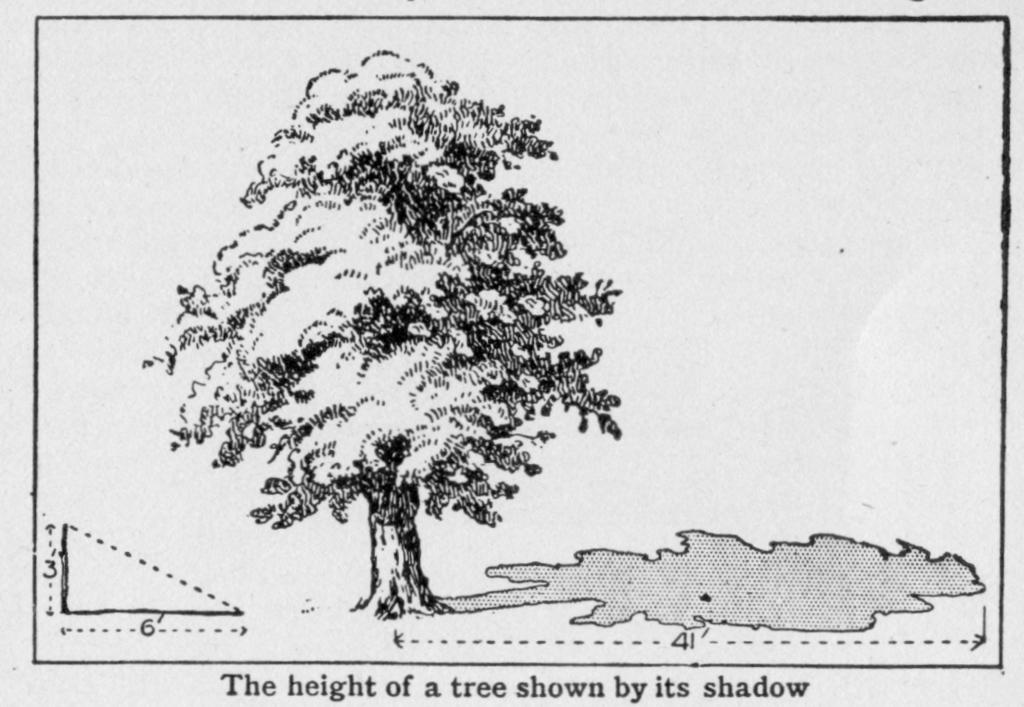
There is a very easy way to measure the height of a wall, or a tree, or a church spire, that any boy or girl can use if he or she can do a sum in simple proportion. It is necessary that the sun should be shining at the time - that is all. Suppose that we have a tree, and the sun is shining, then the shadow of the tree is cast on the ground.

We must measure the distance from the extreme point of the shadow to the place right under the top of the tree. If the top point of the tree is right above the middle of the trunk, then we must calculate half the diameter of the trunk in making our measurements. Suppose that the distance from the point of the shadow to the trunk of the tree is 40 feet, and that the tree is 2 feet thick, then the total distance is 41 feet (40 feet plus half the diameter of the tree).

Now we take a stick, of which we know the exact length. Suppose that it is three feet long. We hold this upright with one end on the ground and notice how far its shadow extends. Then we measure the length of the stick's shadow, and perhaps find that it is 6 feet long. Now we multiply the length of the tree's shadow (41 feet) by the length of the stick (3 feet), and divide by the length of the stick's shadow (6 feet). The answer we get is 20 1/2, and we know that the tree is 20 1/2 feet high.

If we get odd inches in our measurements, we can work the sum out in inches instead of in feet. We can also get the answer - though not quite so correctly - by seeing how many steps it takes to go from the edge of the shadow to the tree, being careful to make our steps as nearly uniform as we can. Then, by measuring the length of one step, we can multiply its length by the number of steps, and find the distance. But in any measurement, whether it be a tree, or a church, or a wall, we must make sure that we take the distance to a point immediately under the highest point, so that if it be a church spire, for instance, we must make allowance for the distance between the wall up to which we measure and the centre of the church tower.

from the 1911 Book of Knowledge: The Children's Encyclopedia (Grolier)
page 1927

Monday, October 10, 2005

Thomas Alva Edison

from the 1911 Book of Knowledge: The Children's Encyclopedia (Grolier)

We have just been to a picture show, perhaps, and have laughed ourselves weary over the funny things we have seen; or perhaps we have watched the telegraph operator tick out our message to a friend who lives hundreds of miles away; or perhaps we have been trying out some new records of the latest songs on our phonograph and, the dusk closing in about us, we have switched on the electric light to enable us to see in picking out the records. We take all these things - the telegraph instrument, the moving picture machine, the electric light, so very much for granted that probably it has never occurred to us to wonder how we got them. And yet we hear the name of their inventor - Thomas Alva Edison, the "Modern day Wizard" - a half a dozen times a month.

It is Thomas Edison to whom we owe the phonograph, the perfection of the telegraph, of the electric light, of the megaphone, of the electric train, of the moving picture machine, and half a hundred other things which it seems that we could not do without. Thomas Edison is looked upon as the greatest inventor of the present century; he has a half a dozen or more factories engaged in making his inventions alone; scarcely a month passes in which he does not take out a patent in Washington, and from all parts of the world men come to seek the presence of the Master.

And yet Thomas Alva Edison, great as an inventor, is remarkably simple as a man. Some sixty odd years ago he began life as a poor boy in a little Ohio town. He went to school for only two months in his life, but his mother, who had been a school teacher, taught him her little fund of knowledge, and, what was more important, taught him something he might never have learned in school, namely, to think for himself.

A Newsboy on the Train

As a boy he did not seem remarkably unlike other lads of his age. When he was seven he began to sell newspapers on the Grand Trunk Railroad in Michigan. His train left Port Huron at 7 a.m. and made its southward trip to Detroit in about three hours. This gave a stay in that city from 10 a.m. until late afternoon. In those days no use was made of the smoking compartment, as there was no ventilation, and it was turned over to young Edison, who not only kept papers there, but soon had it fitted up as a laboratory, where he spent every spare moment fussing with chemicals, joyously absorbed in "inventing" things. Here in this eager-eyed newsboy was the born inventor.

One day a catastrophe occurred. The train which was running at thirty miles an hour over a piece of poorly laid track, was thrown suddenly aside with a violent lurch, and before young Edison could catch it, a stick of phosphorus was jarred from its shelf, fell to the floor and burst into flame. The car took fire, and the boy, in dismay, was still trying to quench the blaze when the conductor, a quick-tempered Scotchman, who acted also as a baggage-master, hastened to the scene with water and saved his car.

On the arrival at Mount Clemens, its next stop, the young inventor and his entire outfit, laboratory and all, were promptly ejected by the outraged conductor, and the train then moved off, leaving Edison on the platform, tearful and indignant, in the midst of his beloved but ruined possessions.

It was through this incident that Edison acquired the deafness that has persisted all through his life, a severe box of the ears from the scorched and angry conductor being the direct cause of his infirmity.

The Boy Proves Himself a Hero

But soon Edison was back at work again. The train on which he sold papers did way-freight work and shunting at Mount Clemens Station. One warm August in 1862, while the shunting was under way, young Edison was loitering about the platform, his glazed cap pulled low down over his eyes to keep out the glare of the sun. His glance wandered idly down the tracks where a train was rapidly approaching.

Suddenly all his languor vanished. With a breathless exclamation he dashed his cap and papers on the ground and tore down the main track. A little boy was playing in front of the on-coming train. Edison caught the child by the waist and rolled to one side - not a moment too soon, for the wheel of the car struck his heel. The two boys were picked up by the frightened train hands and carried to the platform, but though cut and bruised, both were quite safe. The grateful father, who was the station-master at Mount Clemens, unable to reward Edison financially, at once offered to teach the boy the art of train telegraphy. It is needless to say the proposal was eagerly accepted.

The Young Telegraph Operator

Edison first obtained regular employment as a telegraph oeprator at Indianapolis when he was eighteen years old. He received a small salary for day-work in the railroad office there, and at night he used to receive newspaper reports for practice.

"The regular operator was a man given to copious libations, who was glad enough to sleep off their effects while Edison and a young friend of his did the work."

But even in the earlier days of his career as a telegraph operator, Edison was more of an inventor than anything else.

"Anything connected with the difficulties of telegraphy had a fascination for him. He lost many a place because of unpardonable blunders due to his passion for improvement. At Indianapolis he kept reports waiting while he experimented with new devices for receiving them. At Louisville, in procuring some sulphuric acid at night for his experiments, he tipped over a carboy of it, ruining the handsome outfit of a banking establishment below. At Cincinnati he abandoned the office on every pretext to hasten to the Mechanics' Library to pass his day in reading."

At Stratford, Canada, being required to report the word "Six" every half hour to the manager to show that he was awake and on duty, he rigged up a wheel to do it for him.

The Young Inventor

Edison was once asked what was his first invention.

"Well," said he in reply, "my first appearance at the Patent Office was in 1868, when I was twenty-one, with an ingenious contrivance which I called the electrical vote recorder. I had been impressed with the enormous waste of time in Congress and the State legislatures by the taking of votes. More than half an hour was sometimes required to count the 'Ayes' and 'Noes'.

So I devised a machine somewhat on the plan of the hotel annunciator. In front of each member's desk were to have been two buttons, one for 'Aye' and the other for 'No' and by the side of the Speaker's desk a frame with two dials, one showing the total of 'Ayes' and the other the total of 'Noes.'

When the vote was called for, each member could press the button he wished and the result would appear automatically before the Speaker, who could glance at the dials and announce the result.

I thought my fortune was made. I interested a moneyed man in the thing and we went together to Washington, where we soon found the right man to get the machine adopted. Imagine my feelings when, in a horrified tone, the man exclaimed: 'Young man, that won't do at all! That is just what we do not want. Your invention would destroy the only hope the minority have of influencing legislation.' I saw the force of his remarks, and the vote recorder got no further than the Patent Office."

Edison obtained his first large money returns from the sale of an improvement of the instruments used to record stock broker's quotations, commonly known as "tickers." His success in this brought a contract to manufacture some hundreds of "tickers," and this adventure into the manufacturing line he carried through with some success. Yet, in speaking of it afterward, he said, "I was a poor manufacturer, because I could not let well enough alone. My first impulse upon taking any apparatus into my hand, from an egg-beater to an electric-motor, is to seek a way of improving it. Therefore, as soon as I have finished a machine I am anxious to take it apart again in order to make an experiment. That is a costly mania for a manufacturer."

It was Edison's success with the "tickers" that induced several New York capitalists to accept his offer to experiment with the incandescent electric light, they to pay all expenses and to share in the profits of the invention. Edison retired to Menlo Park, about twenty-five miles beyond Newark, N.J., to work out his invention. Patiently he experimented and re-experimented. At one time all the lights he had started burning suddenly went out, one after the other. Edison was stunned by the catastrophe. He began a series of exciting and exhaustive experiments. For five days he remained day and night at the laboratory. His eyes grew weak, studying the brilliant glow of the electric light. He could not sleep, for the moment he closed his eyes a dozen new tests for the lamp suggested themselves.

To add to the discomfiture of the inventor, a professor of physics in one of the well-known colleges declared in a newspaper article that the Edison lamp would never last long enough to pay for itself.

"I'll make a statue of that man," said Edison, grimly, "and I'll light it brilliantly with Edison lamps and inscribe it: 'This is the man who said the Edison lamp would not burn.'"

Such persistency would not fail to win out. With the perfection of the incandescent lamp came the formation of the Edison General Electric Company, involving the consolidation of the immediate Edison manufacturing interests in electric light. Today this company employs from twenty to twenty-five thousand people.

The Phonograph

When Edison was barely thirty years old he astounded the world by inventing the phonograph. He had a large laboratory now with a staff of men working under his directions. One day he draughted a sketch and gave it to a workman to make up into a machine. When the workman, who was a German named John Kruesi, brought the completed machine to him, Edison announced that he was going to record talking and then have the instrument give it back.

"To me it seems most absurd," shrugged Kruesi.

Edison bent over the machine and shouted lustily:

"Mary had a little lamb,
Its fleece was white as snow,
And everywhere that Mary went
That lamb was sure to go."

Then he adjusted the reproducer.

"Mary had a little lamb," the machine announced squeakily For a moment even Edison himself was taken aback. John Kruesi looked at the simple little instrument with an awe-struck face.

"Mein Gott in Himmel!" he ejaculated.

But this first phonograph was a very crude machine in comparison to the one we have now and Edison and his experimenting force worked over it for years before he could find a substance just suited for the making of a perfect cylinder.

"We started out using soft wax," said Edison, "but that was too soft. Then we tried every kind of wax and hardening substance. We invented new waxes. There was something objectionable about all of them. Then somebody said something about soap. That worked better, but it wasn't what we wanted. I had seven men scouring India, China, Africa everywhere, for new vegetable bases for new soaps. After five years we got what we wanted, and worked out the records that we use today. They are made of soap - too hard to wash with and unlike any other in use, but soap just the same."

The Electric Railroad

The electric train such as is used on the New York Central Railroad now is not the least of Edison's gifts to the world. When Mr. Villard of the Northern Pacific Railroad asked Mr. Edison if he could invent some way of running that road by electricity, Edison replied: "Certainly, but it is too easy for me to undertake; you can get someone else to do it."

"But I want you to tackle the problem," Mr. Villard insisted.

Once at work, however, Edison threw himself into the project in his usual whole-souled way. He invented a scheme of a third rail and shoe, and erected it in the yard of his new home in Orange. One day Edison asked some mechanical engineers down to see the road in operation. He invited them to take a trip in his new engine. Not without reluctance the gentlemen mounted the cab of the queer little machine and Edison started off at full speed, up hill and down dale and around sharp curves at the rate of forty miles an hour.

"When we go back, I am going to walk," remarked one of the visitors, trying to be casual. When the train gave an unusual lurch, one of the other gentlemen feebly protested at the rate of the speed over the sharp curves. Edison, absorbed and delighted in the engine, replied confidently, "No, no, it's all right. We've done it often." Just then the train gave an extra large bump, jumped the track, hurling all the occupants save Edison, helter skelter in every direction. "Edison was off in a minute, jumping and laughing, and declaring it a most beautiful accident."

His German assistant, Kruesi, his face cut and bleeding, regarded him woefully from where he sat in a clump of bushes. "Oh, yes, it is pairfeckly safe!" he remarked sarcastically. Fortunately no severe damage was done and in a few moments they had the train on the track again in running condition, but it is not recorded that the visitor rode back.

The Master Inventor

So step by step Edison mounted up the ladder of invention until he became generally recognised as the "Modern Wizard." He made machines for the crushing and grinding down of mine ore; he entered the cement business and placed the finest, hardest cement in the world on the market, and conceived the idea of houses of cement poured into iron molds, which should be fireproof, waterproof and vermin proof, and all this at very moderate cost; he produced the motion-picture machine; he developed his wonderful Edison storage battery for street car propulsion. And these are but a few among the dozens of well-known inventions that have placed the world forever in the debt of this great Master Inventor.

His influence in the development of manufacturing interests of our country has been enormous. And what has been at the bottom of this man's marvellous success in whatsoever he undertakes? A strong body, a clear and active mind, a wide imagination, a capacity for great mental and physical concentration, an iron nervous system, intense optimism, courageous self-confidence and indomitable persistence.

"Edison moves among his complicated series of shops and experiments with such energy and yet such a seeming lack of order that he is the despair of all the men who try to analyse him. To see him moving through his great laboratories, head bowed, hands in pockets, his face set in an expression of intense mental preoccupation, his hair carelessly combed whichever way it may please it to fall, his eyes focused miles away except when he flashes into someone else's a look of instant understanding, his whole appearance, except for the eyes and the humourous yet grim mouth, is that of a dreamer rather than a tireless worker."

"Nearly every man who develops a new idea," says Mr. Edison himself, "works it up to a point where it looks impossible, and then he gets discouraged. That's not the place to get discouraged, that's the place to get interested. I can't recall a single problem in my life, of any sort, that I ever started on that I didn't solve, or prove that I couldn't solve it. I never let up until I had done everything that I could think of, no matter how absurd it might seem."
Friday, October 07, 2005

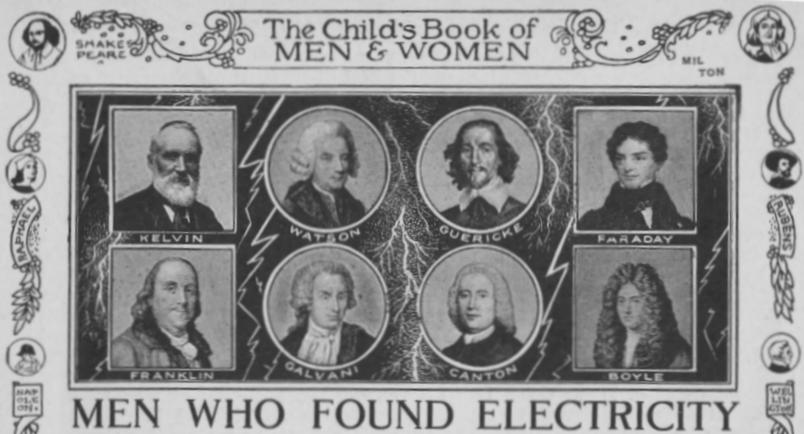
Men Who Found Electricity - Part Four

The Danish Professor Who Turned the Compass from the North

Now we must think for a moment of magnets. They had long been made. Soft iron could be magnetised by rubbing the loadstone upon it, but magnets like these soon lost their magnetism. Steel, after being magnetised by the loadstone, does not lose its magnetism. Once a magnet, always a magnet, with the hard steel. Now, many clever men had been wondering if there might not be some connection between magnetism and electricity, and Professor Oersted, a Danish scientist, living at Copenhagen, found, in 1820, that by passing an electric current from a Voltaic battery through a wire he could alter the position of the magnetic needle.

The magnetic needle is the little steel pointer of the compass which, when not interfered with, points to the north. Oersted found that, though the whole earth is one vast magnet, its power to attract the magnetic needle to the north is not great enough to prevent the point of the needle from being drawn aside by a strong electric current. Oersted showed that when the wire bearing the electric current is placed over the needle, the needle turns its head from the north to the east, but that if the wire be placed underneath the needle, the needle turns its head to the west.

What Oersted did sounds an interesting trick for a conjurer to do, but see what the effect of it was. The fact that an electric current turns the magnet is the beginning of the power which enables us to have telegraphs and telephones, and to do all the work of which the marvellous electric current is capable. Oersted had opened the door to the great field of discovery in what we call electro-magnetism. But the discovery did not remain there, or it would have been of no use to mankind.

Michael Faraday, The Blacksmith's Son Who Helped to Change the World

It remained for one of the finest English sons of science to carry the work to perfection. This was Michael Faraday, who was born in 1791, the son of a poor London blacksmith. After very little schooling he was aprenticed to a bookbinder, and after working hard all day he would study science at night. One day a gentleman, on entering the shop, found the boy at work binding an encyclopaedia, and studying hard at the article in it on electricity.

The gentleman was surprised to see a boy so interested in a subject of such difficulty, and questioned him. He found that Faraday, working late at night, had already been making experiments of his own, though he was too poor to possess anything but an old bottle for his battery. The visitor was so pleased that he gave him four tickets for the lectures which Sir Humphry Davy was then delivering at the Royal Institution. Faraday was as pleased as if anybody had given him a fortune. He went to the lectures. He made notes of what he heard, and then at the end of the lectures he went, in fear and trembling, to the great man and showed him his notes.

Davy was surprised to see what the poor boy had done. But he remembered how poor he himself had been as a boy, and how he had had to struggle to educate himself, and his heart warmed towards the humble apprentice. Faraday told him that he wanted to be a scientist, and Davy, after doing all that he could to test his faith, had the boy appointed as his own assistant.

He helped him in his education, he took him on the Continent and let him make numberless experiments, and in course of time, when Faraday had grown up and become famous for his work in science, he succeeded the great man who had been so good a friend to him.

Faraday's life was a long, beautiful story of good and wonderful achievements. He did more for scientific learning than any other man of his day. His lectures and writings were upon the most difficult subjects, yet he wrote and talked so simply that even children could understand him and find delight in his words. All that he did for science is too much for us to talk of here; but the thing which we have to note is one of his wonderful discoveries concerning electicity and magnetism. Oersted had found that the electric current will turn the magnetic needle. Faraday worked until he discovered that the magnet will electrify wire through which no current is passing! That clearly established the relationship between magnetism and electricity.

The result of this was of great importance. It meant that men no longer had to depend upon the small current of electricity which was chemically produced in jars or batteries. First of all we have a coil of wire which, when electrified and placed near a magnet, itself becomes a magnet, with a north pole and a south pole, the north pole of the wire being attracted by the south pole of the magnet, and the south pole of the wire being attracted by the north pole of the magnet; while the north pole of the magnet drives away the north pole of the electrified wire, and the south pole of the magnet drives away the south pole of the wire.

But we can make the north and south poles of the wire change places. If we send the current in by one end, then the front of the wire is the north pole; if we send the current in by the other end of the wire, then the back part of the wire becomes the north pole. The moment the current is turned of, or the connection is broken, as we say, the coil of wire ceases to be a magnet.

William Sturgess, in 1825, made an electro-magnet of the highest value. He found that if we take a piece of soft iron and wrap wire about it, it becomes a far more powerful magnet, when electrified, than the ordinary magnet itself, and of course it can be made a magnet or not a magnet as often as we turn the current on or off. That gives us a powerful magnet which, as we have seen, can electrify any other coil of wire brought near it.

Faraday, working on, found that the coil of wire, on coming near the magnet, passed through what he called lines of force - certain avenues through which the magnetic influence is travelling. Therefore the more often that the coil passed through these lines of force the more often would it feel the effects.

The next step, therefore, was to make a coil of wire which was attached at its ends to a revolving wheel. The coil, by turning round rapidly, received repeated impulses from the magnet. The current set up in this coil can be led away by wires into a receiver and stored, to eb sent over wires hundreds or thousands of miles long, to do all manner of work, as often as it is wanted.

The use of the electro-magnet eneables us to et force for driving engines, for telegraphing and telephoning, for lifting huge weights, and for all sorts of work. It is perfectly obedient, for the electric current which controls it can be turned on or off at any moment. The greatest part of the foundations of electric science had now been laid. All that remianed was to apply to practical purposes the knowledge which these first workers had given the world.

Long intervals passed before we could take advantage of all the theories. The electric telegraph dates from about 1837; the cables under the sea from 1852, electric bells from about 1855, the telephone and electric light from about 1878. It was possible by 1883 to produce electricity in sufficient quantities to sell it like gas to people who wished to use it. In the same year the first electric trolleys began to run, and electric railways appeared in 1892.

Wireless telegraphy was known in its first stages long ago, but it was not until 1899 that it could be used. One of the most brilliant electricians was Lord Kelvin, who died only in 1907. He used to be Mr. William Thompson, but Queen Victoria honoured him by making him Lord Kelvin. We shall read more about him on another page.

So, from the rubbing of amber to make it attract chaff and pieces of straw, men got to friction machines and excited stockings; from that to the Leyden jar, and so on to the Voltaic pile and cell and battery; then on to the electro-magnet and the great dynamos, which use up the knowledge of the men who discovered electro-magnetism, and produce electricity enough to do half the work of the world.

Thursday, October 06, 2005

Men Who Found Electricity - Part Three

The Wonderful Things Sir William Watson did with Two Leyden Jars

The Leyden jar, though first made in Holland, was made perfect in England by Sir William Watson, another genius of those early days. Watson was a poor tradesman's son, and was born in London, in 1715. Apprenticed to a chemist, he loved science, and when he had made enough money to live on he gave himself wholly to science. He improved the Leyden jar by covering it inside and out with tinfoil. This had important results. He used wires for carrying the current from one Leyden jar to another Leyden jar. Sending the current along the wire, he found that it gave a shock to the person holding the far end of the wire, two miles away, practically at the very instant at which it was released from the Leyden jar.

This proved that the action of electricity is instantaneous - a most important thing, as it afterwards proved in telegraphy.

More wonders Sir William did with the mysterious force. He electrified a piece of ice, and with that set fire to spirits. He did the same with a drop of water which had been electrified. He fired the gunpowder in a gun with an electric spark, and showed many pwoers of electricity which had never before been suspected.

By this time the world was getting to know a great many things that electricity could be made to do, but they still knew nothing of its nature.

Benjamin Franklin, Who Helped to Free America and to Find Electric Power

There was living in America one of the greatest men the world has seen, Benjamin Franklin, the man who first captured fire from the sky and brought it to the ground. He was born at Boston, Massachusetts, in 1706, and began his career, with very little schooling, in a small printing office of one of his brothers. He was very poor, but he had a splendid brain, and never troubled about being short of money. He educated himself entirely by his own efforts. He was first a printer, going to London to learn what he could there, then setting up in business for himself in Philadelphia.

So famous did he become that he was chosen by his countrymen to go to England as their representative. War was about to break out between Great Britain and the American colonies, and he did all that he could to prevent it. Seeing that his efforts were hopeless, he returned to America, where he found that the war had already broken out. He became a leading member of the Government which helped to give America her freedom from British control, and then was sent to France as Ambassador to gain the support of that country against England. After all, he had the delight of opening the arrangements which led to peace between England and America.

The last thing he did in public life was to make a prayer to the American Government against slavery in the United States. That prayer of his was not to be answered until many a year after he had been in the grave.

So much for his public life. The more important thing for us here, however, is what he did with electricity.

How Benjamin Franklin Sent Up a Kite to Bring the Lightning Down

In the midst of all his work he had time to study and make experiments, so that he was honoured all over the world for his knowledge about the tides and the weather, about colours, and, most of all, about electricity. He was one of the men who suspected that lightning and electricity are one and the same thing. But Franklin was not content to remain guessing; he put his belief to the proof. He made a kite of silk, and on the top of it he fixed a thin wire.

He tied a string to the kite, but near his hand he attached a silk ribbon to the string, and where the string and ribbon joined he fixed a metal key. Then one day, when a thunderstorm broke over his home, he sent up his kite into a thundercloud, and waited in a doorway to watch the result.

He had printed a statement expressing the belief that everything that had been done with electricity was no more than was to observed in lightning. Now had come the hour when he was to make his reputation as a scientist secure, or be laughed at by the whole world. He was very anxious as he stood and waited in the doorway with his son.

The first thundercloud passed without any sign at all, and Franklin feared. A second came over the kite, and he now saw that little loose strands of the string stood out stiff and bristling. He put his finger towards them, and they were attracted towards it. He placed his finger on the key, and instantly he felt a shock and saw an electric spark. Rain fell now and wetted the string of the kite, and electricity ran down the moistened string, and was so abundant that he was able to fill his Leyden jar from the key.

He had proved that lightning is electricity. He made other trials, and found that some clouds are charged with positive electricity and some with negative electricity, exactly in the same way as in the electricity produced by different bodies on earth. No sooner had he made sure of his facts than he set to work and built lightning conductors.

If lightning could be drawn from the skies, as his kite had shown that it could, then surely, he thought, it should be possible to guide into the ground the lightning, which, if left to strike freely, might destroy the house. It was in 1752 that Franklin made his great discovery. He lived for thirty-eight years afterwards, and when he died, in 1790, not only the whole of America, but the whole of France went into public mourning for him.

Discovery was now well on the way to practical success, and every year added surprises. John Canton, who was born at Stroud, in 1718, became a schoolmaster, and invented valuable electrical instruments. He was the first man to manufacture powerful artificial magnets, and discovered that the air of a room can be electrified just like so many other things.

Baccaria, a celebrated Italian, found that the air surrounding an electrified body itself becomes electrified. Then Robert Symmer made the amusing discover that silk stockings and worsted stockings, when warmed and rubbed together, become so electrified that a Leyden jar can be filled with the current from them.

More important was the work of Henry Cavendish, the grandson of the second Duke of Devonshire, born at Nice, in 1731.

He was very rich, and very strange in his manner. He lived the life of a hermit in a beautiful London house. He hated the sight of strangers - not because he was an unkind man, but because he was so shy and modest. His female servants were never allowed to see him. If he had any orders for them he would write them down and leave a note on the hall table.

Science was the great joy of his life. The chief thing that he did for electricity was to show that iron wire conducts electricity 400,000,000 times as well as water does. By the aid of electricity he exploded oxygen and hydrogen, and got pure water as the result.

Cavendish lived until 1810, and in his time two men arose who quite changed the method of producing electricity. One was Luigi Galvani, who was born at Bologna, Italy, in 1737, and died there in 1798. The other and greater was Alessandro Volta, born in 1745, at Como, where he died in 1827.

Galvani, when experimenting with an electric machine, found that the legs of a dead frog were set to work by an electric shock. He determined to see if lightning would have the same effect; but while he was fixing the frog by a copper skewer to the iron railing of his balcony, he saw the twitching renewed the moment the copper touched the iron.

Galvani declared that the electricity existed in the tissues of the frog. When Volta heard of this, he set to work to prove that the body of the frog did not contain the electricity. He argued that it was produced by the contact of two different metals, and he proved that he was right.

He placed a disc of copper on his table, and on top of that he placed a piece of cloth which had been soaked in sulphuric acid and water.

On top of that he placed a disc of zinc. Next he added copper, cloth, and zinc again, and so on, in that order, until he had built up a pile. It was a pile of pairs of zinc and copper discs, each pair having a moist piece of cloth between. Then he fastened a wire to the zinc disc at the top of the pile, and a second wire to the copper disc at the bottom of the pile.

Alessandro Volta, the Man Who Made the Electric Bell Ring

Volta put the free ends of the two wires together, then separated them. As they were drawn apart, the electric current which had been set up in the pile caused a spark at the ends of the wires. Here, then, was the first instance of the manufacture of electricity by chemical action.

It was easy soon to improve on the Voltaic pile. Instead of placing the discs and cloth on the table, for the moisture quickly to dry up, he put the pile into a jar, or cell, filled with the water and acid. That was the Voltaic cell, which to this day is used for producing electricity by chemical action. This invention belongs to the year 1800, but more than a century afterward we still sometimes use the Voltaic cell as the battery for our electric bells, and all manner of other things.

This invention caused much excitement, and set men still harder to work. They found now that they could produce electricity in this way as they liked, and cause it to flow in a steady current over wires, not letting it fly away immediately after it was created as it did from amber and other things. They found, among other things, that the current would heat wires, and this led at once to Sir Humphry Davy's discovery of the electric flame from which we get electric light, as we read on page 657.

Men Who Found Electricity - Part Two

The Bluecoat Boy Who Sent Electricity Along a Line of Thread

An ivory ball did not seem a promising thing with which to work, but Gray got a glass tube, and into its ends he fitted two corks. Into one cork he fixed his ivory ball, and, to his delight, he found that when the glass was rubbed it passed on its electricity through the cork to the ivory ball, and the ivory ball would now attract little light things just as the glass itself would.

This led Gray to many splendid experiments - little in themselves, but dazzling by their results, considering how he was working in the dark. He tried if silk would conduct electricity, and found that it would not. So he tried pack-thread, and found that that did. He put up a line of pack-thread, and supported it by loops of silk, which would not conduct the current away from the cotton. He was able to send a current of electricity along his line of thread for a distance of 886 feet. That was a wonderful achievement.

An industrious Frenchman was at work on similar lines at this time. This was a man named Dufay, who, born in 1699, died when only forty years of age, in 1739, three years after Gray. Dufay went over Gray's experiments, and went beyond them. He found that glass tubes could be used to hold up the pack-thread, and he found, too, that by connecting himself with the electrified thread he himself became electrified, and that when another person touched him there was a crackling sound, accompanied by a spark. But the great thing which Dufay did was to find out that there are two kinds of electricity, what we now call positive and negative.

How Men's Knowledge of Electricity Began to Grow

The two kinds exist in a substance, and are at rest until that body is rubbed. Thus two electrified silks will not come together, but silk and worsted will, though two electrified woollen threads will keep as far apart as possible. This is like the loadstone or magnet. That part of the loadstone which points to the north will drive away the north pole of another magnet, but will attract the other magnet's south pole, as if it loved it. North and south go together in the magnet, and opposite kinds go together in electricity.

Inventions now went forward rapidly. Machines were made for rubbing glass cylinders with cushions and other things, and they produced so much electricity that sparks could be formed which would set light to spirits, to wax, to pitch, and other things which were thoroughly heated by friction. The increase of knowledge was now turned to account in a new way. Several men saw that, if electricity could be so easily produced in the open air, it ought to be still stronger if produced in a vessel, away from the free air, where it could be kept and tapped as required, instead of being allowed to escape. This was near the middle of the eighteenth century.

The Shock That Surprised the Professor with a Jar of Water

A monk living abroad, a foreign inventor, and a professor named Muschenbroek, of Leyden in Holland, each seem to have had the same idea about the same time, and the outcome was what is called the Leyden jar. The professor electrified some water in a bottle or jar, which was covered with a metal stopper, through the centre of which ran an iron rod.

From this the electricity could be conducted as it was wanted. The professor made his discovery of the power of the electricity by accident. Holding the jar in one hand, he chanced to touch the iron rod with the other hand, and received such a shock that he declared that he would not for the crown of France risk such another.

Men Who Found Electricity - Part One


from the 1911 Book of Knowledge: The Children's Encyclopedia (The Grolier Society)
starting on page 2113

Electricity is one of the most wonderful forces placed ready for the service of mankind, yet it is one of the things which hid its secret longest from us. Men discovered how to turn the strength of animals to account; how to make the winds drive our ships across the seas; how to apply the power stored up in coal; how to raise steam, and with it change the face of the world. Yet electricity is greater than these. It can do almost anything. It can light a city, supply power for lifting the heaviest weights, drive trains and trolleys, cook a dinner, heal a sick child, and kill us if we are not careful. It is in almost everything, though it does not move. All that we have to do is to excite it, to bring it out, then catch it, so that we may use it as we need it. It is so valuable and does such marvels that it is hard to believe that it existed for thousands of years in the earth and in the air quite unknown to men.

The very name of electricity tells a story of the mystery in which it was hidden for thousands of years from men. A great man named Thales, of whom we read in another part of this book, who lived nearly seven hundred years before Christ was born, noticed that amber, when rubbed with another material, became heated, and that when in that condition it would draw towards itself little pieces of feathers and other tiny light articles. It is said that in the old time the women of Syria used amber to catch up leaves, straws, and other things clinging to their clothes.

A great writer named Pliny, who was born in the year 62 A.D. and died about 114, wrote about amber and its ways. He likened it to the loadstone, the properties of which were well known in his day. We all know that the loadstone is a certain ore which, if allowed to hang by a string, always has one of its points towards the North Pole and the other towards the South Pole, and will attract other metals towards itself. Another thing that Pliny knew was that the electric fish can give such sharp electric shocks as to make a man quite ill. But he never thought that there was any connection between the power of the amber, the fish, and the loadstone.

It was not until the sixteenth century was well advanced that the world began to take a real interest in electricity. Then William Gilbert, a thoughtful scholar, who was one of Queen Elizabeth's doctors, set himself to make experiments with a number of substances to see whether they, like amber, would, when warmed by friction, attract other bodies. He found that many, including sulphur, sealing-wax, gems, solid resin, rock-salt, and many other things, had the same power. They would attract metals, stones, earths, fluid, and even heavy smoke.

The Colchester Man Who Gave Electricity Its Name

As the first man to examine the question, he had to find a name to describe the condition which he excited in these objects. Now, as amber was the first substance known to possess this power of attraction, and as the Greek name for amber is elektron, Dr. Gilbert gave the name electricity to the condition which heat and friction excited in the things he tried. He is called the father of electrical science. Gilbert lived sixty-three years, dying in 1603; and his life was very valuable to the world, for every year sine he began his discoveries our store of learning concerning electricity has gone on increasing.

Gilbert was a Colchester man. He was followed by a famous Irishman, Robert Boyle, a son of the Earl of Cork. Boyle was born in Munster, in 1627, twenty-four years after the death of Gilbert. He was a wonderful scholar as a boy, and at ten learned algebra simply because he loved to exercise his mind. He invented a famous air-pump, and taught the world all about the condition and qualities of air. His work for electricity was to show that electricity remained for some time in a substance after rubbing had ceased; and to add new substances which could be electrified. The mere fact that he was noticing electricity was sufficient to set other men thinking about it, for his reputation was very high, especially with the great men on the Continent of Europe.

The Man Who Fastened Two Things Together With "Nothing"

Boyle died in 1691, five years after the death of Otto von Guericke. This clever man was born at Magdeburg, Prussia, in 1602, and after an excellent education visited England and became acquainted there with the scientists of that day. He invented the first air-pump, but that of Boyle's was so much better that the Prussian invention was soon forgotten. Guericke was the first man to show the immense power of a vacuum. He made two hemispheres of metal - that is, two large metal cups, the edges of which fitted together. There was a tape to each, through which the air could be drawn out by the air-pump. When this was done, so tightly did the two hemispheres cling together that not until the united strength of fifteen horses had been employed could they be pulled apart.

Guericke lived far too early. He discovered a way of making electric light, but nobody knew what it meant. Electric lighting did not become general until 1878. What Guericke did was to make a ball of sulphur inside a globe of glass, then break off the glass so as to expose the sulphur. This he rubbed in the dark, and found that it gave forth a light, accompanied by sound. He it was who discovered also that bodies which have not been electrified by friction become electrified when brought into contact with other bodies which have been electrified.

Sir Isaac Newton did one notable thing for electricity by showing that a disc of glass, when placed in a brass cylinder and electrified, would attract paper so strongly as to make it leap about in the cylinder.

The Man Who Showed That the Electric Spark was Like Lightning

Next came the experiments of Francis Hawksbee, who was famous in 1705 as a scientist, when he was elected a member of the Royal Society. It is not known when he was born, though the year of his death is given as about 1713. He made important experiments with air and mercury, and with a machine for producing electricity by rubbing a glass cylinder with the hand.

He, for the first time, drew attention to the fact that the electric sparks which he was able to produce, and the crackling noise they made, resembled lightning.

His son, Francis Hawksbee, who was born in 1687 and died in 1763, was a gifted maker of scientific instruments, and was the first man in London to lecture and at the same time make scientific experiments to illustrate his theories.

The elder Hawksbee wrote much about his discoveries, and his books, translated into French and Italian, were of great assistance to scientists on the Continent.

All this may seem unimportant, but each of these little discoveries led to other and more important discoveries.

A tree in a forest may not seem of much use as a dwelling for a man, but when the tree-feller and the carpenter and the builder have each done their share, that tree becomes an essential part of a house, all the parts of which have been pieced together, just like the building up of a great science. Now we come to the first step which brings us nearer to practical uses of electricity.

Stephen Gray was a Bluecoat boy in London at the beginning of the eighteenth century, and by some happy chance gave up his life to the study of electricity. He made a grand discovery. He found that we can divide matter into two classes - that which can be electrified by friction, and that which cannot be electrified by friction.

Then he went a step further and found that the non-electrics could be made electric by being placed in contact with those which were already electrified. This means, as we should say now, that he had discovered that some substances are conductors of electricity, and some are non-conductors of electricity.